

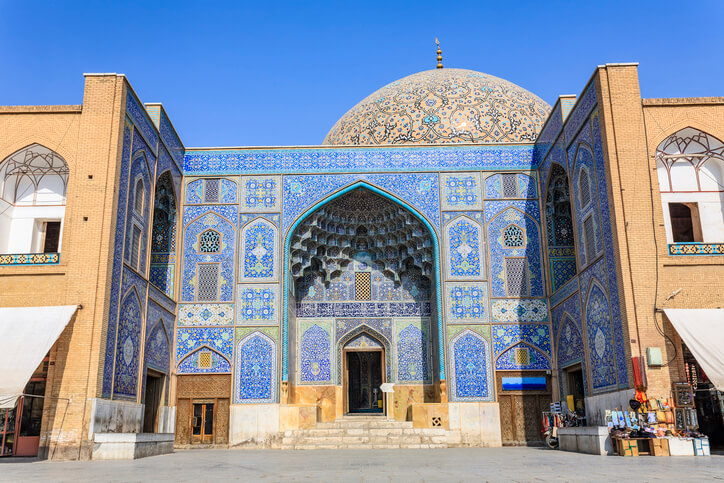
Moschea Sheikh Lotfollah Isfahan (Istock, Credit: TAKAYUKI UEDA)
Anna’s expertise has made her a sought-after advisor for governments and corporations navigating the world’s most volatile regions. Her reputation is built on a hands-on, pragmatic approach—a sharp departure from the detached, theoretical lens often applied to complex global realities. Yet, Anna Prouse is also a traveler whose journeys are defined by cultural depth, and it is this unique perspective that sits at the heart of our conversation.
Iran is, once again, at the center of global attention. In your opinion, what is the most important thing we overlook when we discuss the country solely through the lens of conflict?
We forget that Iran is Ancient Persia, and that Iranians are Persians above all else. The West often makes the mistake of lumping the people together with whoever holds political power at the moment. While Iranians may struggle to unite behind a single leader, they possess—unlike many other nations—a rock-solid national identity of which they are deeply proud. Theirs is a millennial patriotism: they are prepared to die for their land and their flag, viewing these as cultural roots that both precede and transcend any conflict.
Is there a significant gap between the Iran Western media describes and the one you came to know through your travels?
I have never seen such a stark disconnect in my life. Arriving in Iran on September 12, 2001—immediately after the attacks on the Twin Towers—I realized that the reality on the ground did not match the narrative being imposed. While Western media obsessively searched for images of burning flags and crowds chanting “Death to America,” the people of Tehran were taking to the streets for spontaneous candlelight vigils to honor the victims. They even observed a minute of silence at the stadium to commemorate them.
It was a profound display of humanity that the media deliberately ignored because it did not fit the ideological confrontation of the moment. At the time, the West was consolidating its alliance with Sunni Saudi Arabia; consequently, the narrative was tailored to cast Iran as “THE” enemy, ignoring the complexity of its social and political reality.
This discrepancy has persisted over the years, even regarding the condition of women—which was improving slowly but steadily, though the media failed to cover it. As far back as 2000, the chador was not mandatory; a simple coat and a headscarf—even a colorful one—were sufficient. I was there. Recently, especially in major cities, we have seen women with their heads uncovered without it leading to arrests or violence. This change became especially visible after the protests following the death of Mahsa Amini in 2022. Since then, the authorities have adopted a silent tolerance strategy. They frequently choose to close both eyes to what has become a widespread and daily form of resistance.
Life on the Iranian streets has always been far more multifaceted than the version we are shown.
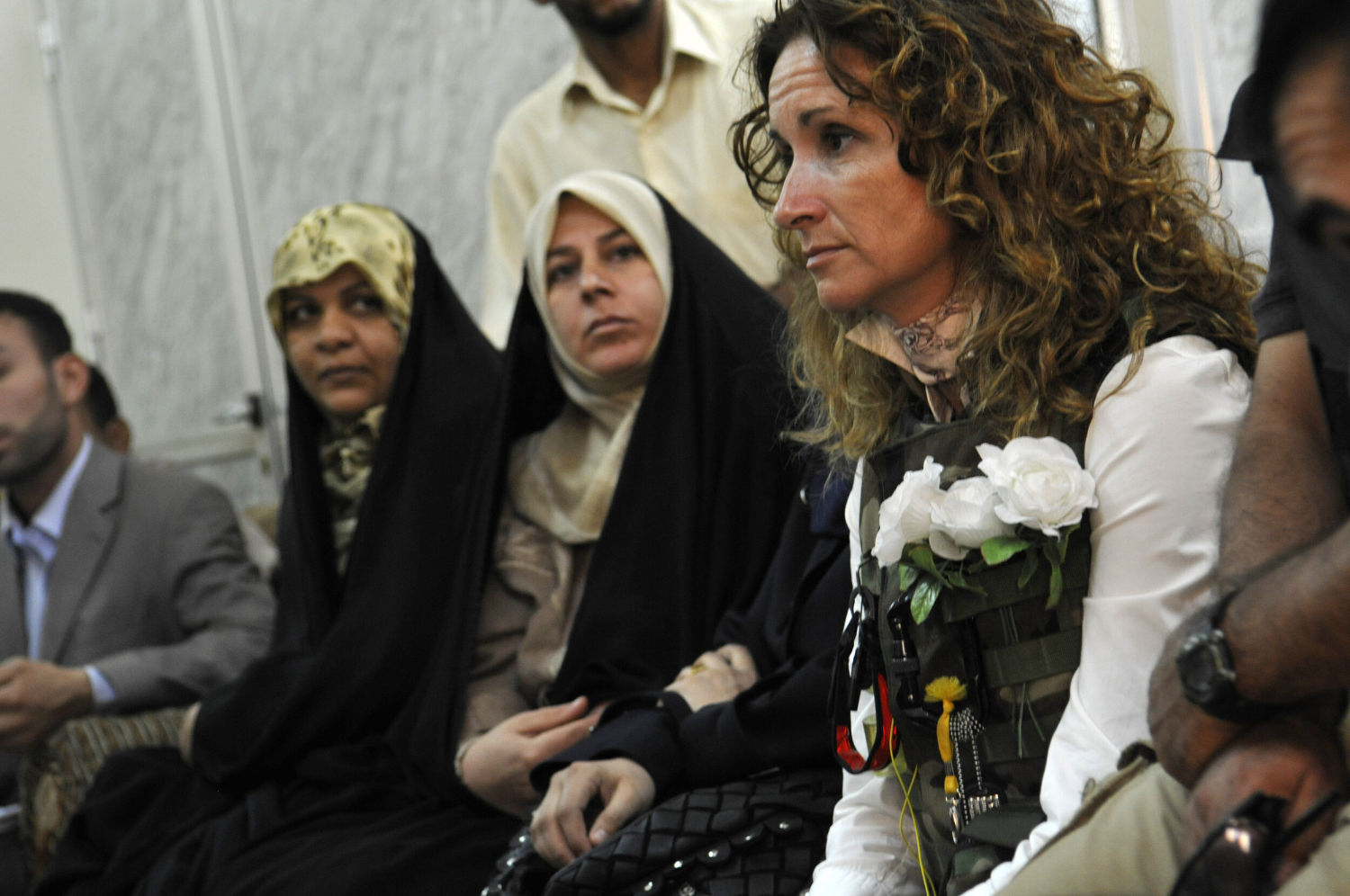
You wrote a guide on Iran. What was the most powerful—or perhaps most unexpected—discovery you made when you immersed yourself in the reality of the country?
Without a doubt: the people. Although the country’s beauty left me breathless, what struck me most was the Iranians’ human warmth, combined with a sharp intelligence and an extraordinary level of education. But Iranians also love to have fun and manage to do so in a way that one would never expect—especially based on what we are shown about the country.
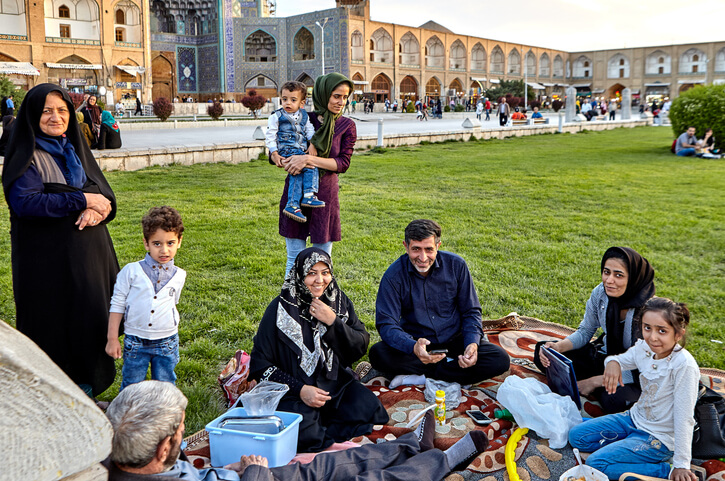
Holy cities like Mashhad are literally divided in two: on one side, women in chadors and religious rigor; on the other, the duster coats and headscarves characteristic of a youth that would never dream of approaching the Mausoleum of the Eighth Imam. Instead, they meet in cafes, restaurants, or on the streets. On Friday nights, life explodes in picnics—a true national institution—while in the mountains, young people climb to spend the night around a bonfire, singing and playing music.
And then, there are the mosques. I know the Muslim world well, and the masterpieces of Isfahan and Shiraz—to name just a couple—are something unimaginable. It is a beauty unlike anything I have ever seen, an architectural perfection. To me, Iran is the pinnacle of Islamic architecture. It is not just about Persepolis and the glorious vestiges of the pre-Islamic past; for millennia, Iran has redefined the limits of architectural genius, building spaces that move past religion into the realm of universal art.
If you had to explain the atmosphere of Iran to a European reader, which images, scents, gestures, or daily rituals would you start with?
I would start, without a doubt, with the color blue. Most people—myself included, before visiting—associate Iran with the black of the chadors. The truth is that Iran is the pinnacle of blue in all its forms: the turquoise of the domes defying the sky, the cobalt of the glazed tiles, and the deep blue of lapis lazuli. It is a color that represents far more than decoration; it is a condition of the soul.
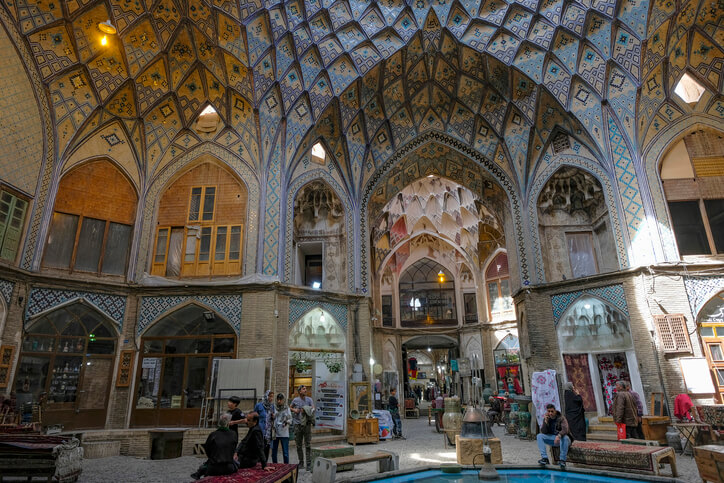
To this, I would add the bazaars—the very quintessence of Iran. They are labyrinths of history where the scent of saffron and spices mixes with the rhythmic hammering of craftsmen. To enter a bazaar is to enter the political and social heart of the city.
Finally, I would describe the ritual of tea and the gesture of Taarof—that complex Persian etiquette of courtesy that governs human relationships. Breathing the Iranian atmosphere means discovering a reality that is both vibrant and millennial—a world that exists in parallel to the political narrative we are constantly fed.
Beyond politics and the news, which elements of Persian culture continue to define the country’s identity?
Poetry! In Iran, poetry is not an intellectual exercise for the elite; it is the lifeblood of every social layer. It is extraordinary to see Iranians from all walks of life reciting verses from the Shahnameh (“The Book of Kings”) or Hafez by heart. The tombs of the great poets are vibrant places, frequented by young and old alike who recite verses and are often moved to tears by the words of their idols.
Here, once again, you encounter the “greys” that make Iran so fascinating. It is impossible not to admire the creativity of a people who skillfully navigate the constraints of a religion where only Allah is deemed worthy of devotion. Iranians have managed to preserve a space of inner and cultural freedom that neither politics nor religion has ever fully occupied. Poetry is their true citizenship.
Which aspects of everyday life most surprise those who arrive with preconceptions shaped by outside media?
The most surprising aspect is the ability of Iranians to navigate the “grey zones.” In the West, we tend to imagine Iran as a monolithic state, defined by rigid rules and absolute intransigence. The reality is far more nuanced. There is an unwritten tolerance that allows real life to flow in parallel to the official narrative.
If I, as a foreigner, could discover where the best private parties were happening within twenty-four hours of arriving in Tehran, it would be naive to think the Revolutionary Guard didn't know as well. Once you cross the threshold of a private home, the scene changes radically: the outward rigor vanishes, replaced by an incredible display of fashion, loud music, and alcohol. The State is aware, but it chooses not to intervene as long as certain lines are not crossed. These boundaries are invisible to us foreigners, but Iranians know them perfectly—they know exactly how to move without breaking them.
Those arriving from the outside expect a prison; instead, they find a society incredibly skilled at turning every prohibition into a silent negotiation. It is a continuous dance between what is forbidden and what is possible.
How much does culture—from art and literature to cinema—matter in portraying an Iran that defies the typical stereotypes?
Iran is not simply a country that has a culture; it is a country that breathes it in every manifestation. And crucially, culture is not an elite luxury. Unlike many of its neighbors, Iran’s link with its past is visceral: archaeological sites are constantly crowded with locals, and even remote locations, like the Tomb of Cyrus the Great, are the destination of an endless pilgrimage. As I mentioned with poetry, this heritage is a lifeblood that runs through every layer of society.
Iranian cinema is incredibly rich, though I note with regret that many films awarded abroad tend to be critical at any cost to satisfy international festival tastes. This happens because these festivals often seek works that confirm the Western public’s existing prejudices, rewarding a dark, hopeless narrative. In doing so, they omit something far more significant than a mere nuance: the profound vitality of Iran and its people.
Finally, we cannot overlook the famous Persian carpets. They are not mere decor; they are a millennial art form and a philosophy of life that people literally walk upon—and eat on—every single day.
In a historical moment in which the risk is that Iran is perceived only as a theater of war, what responsibility do journalism, books, and travel have in restoring complexity?
The responsibility is enormous: one should first of all describe Iran for what it truly is. A week ago, for example, I wrote an article/post specifically on this theme, emphasizing how we are risking erasing Ancient Persia from the face of the earth. It seemed like an obvious reflection to me, an elementary concept: who would ever want to take the responsibility for seeing a country destroyed that ranks among the top ten in the world on the UNESCO List for historical and cultural heritage?
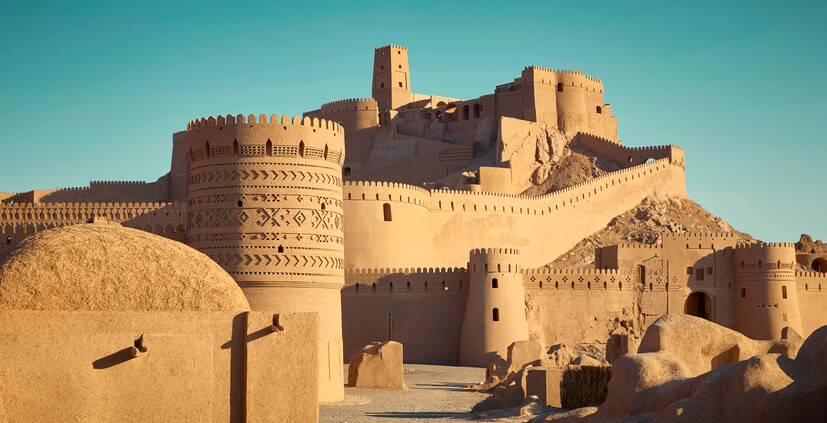
Yet, some reactions were surprising and left me deeply embittered. I was accused of being a snobbish and elitist person. I was even told that, if Iranians could choose between the bombing of a supermarket and that of Persepolis, they would undoubtedly prefer to sacrifice Persepolis. It is a logic that I find deeply misleading and based on the ignorance of people who have never set foot in Iran. Comments like this (as well as others asserting that the Ayatollah regime had systematically destroyed archaeological sites, which is not true at all) demonstrate how much the work of journalists, writers, and travelers is necessary: doing justice to the reality of the facts means remembering that destroying a monument is not just tearing down stones, but erasing the identity and memory of a people. Belittling culture in the name of “material priorities” is the first step toward stripping the Persian people of their dignity.